
Python’s error handling has two ideas you won’t find in most languages: the else clause on try blocks, and the with statement for automatic resource cleanup. If you’re coming from Java, forget checked exceptions — Python has none. If you’re coming from Go, forget error return values — Python uses exceptions for control flow and it’s idiomatic.
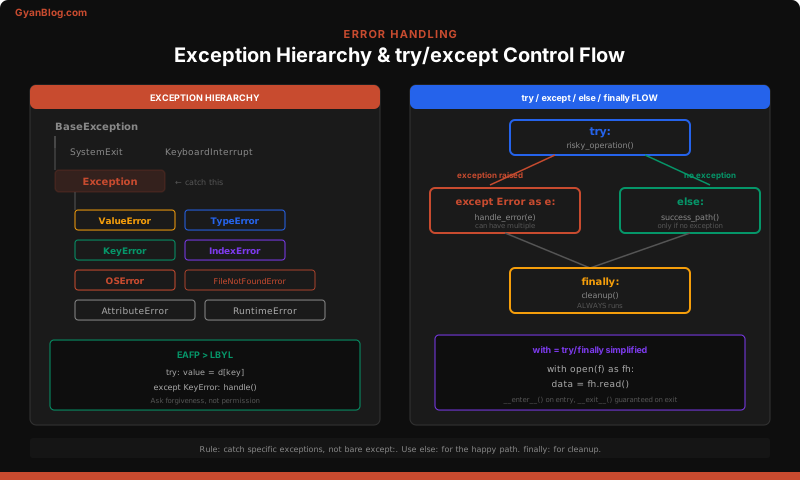
Exception Handling — try/except/else/finally
The full form has four clauses. Most languages give you three; Python adds else.
def parse_config(path: str) -> dict:
    try:
        with open(path) as f:
            data = json.load(f)
    except FileNotFoundError:
        print(f"Config not found: {path}")
        return {}
    except json.JSONDecodeError as e:
        print(f"Invalid JSON at line {e.lineno}: {e.msg}")
        return {}
    else:
        # Runs ONLY if no exception was raised in try
        # Keep code here that shouldn't be protected by except
        print(f"Loaded {len(data)} keys from config")
        return data
    finally:
        # Always runs — cleanup goes here
        print("Config parse attempt complete")
Key rules:
exceptcatches exceptions from thetryblock only.elseruns iftrysucceeded — use it to separate “happy path” code from the guarded block.finallyalways runs, even if youreturnfromtry,except, orelse.
Catching Multiple Exceptions
# Catch several types with one handler
try:
    value = int(user_input)
except (ValueError, TypeError) as e:
    print(f"Bad input: {e}")

# Separate handlers for different types
try:
    result = remote_api_call()
except ConnectionError:
    retry()
except TimeoutError:
    use_cached_value()
except Exception as e:
    # Catch-all — last resort only
    log.error(f"Unexpected: {e}")
    raise  # Re-raise after logging
Gotcha: bare except: (no exception type) catches BaseException, which includes KeyboardInterrupt and SystemExit. Never use bare except unless you re-raise immediately.
Exception Hierarchy
Python’s exception tree matters when you decide what to catch.
BaseException
 +-- SystemExit
 +-- KeyboardInterrupt
 +-- GeneratorExit
 +-- Exception
      +-- StopIteration
      +-- ArithmeticError
      |    +-- ZeroDivisionError
      |    +-- OverflowError
      +-- LookupError
      |    +-- IndexError
      |    +-- KeyError
      +-- OSError
      |    +-- FileNotFoundError
      |    +-- PermissionError
      |    +-- IsADirectoryError
      +-- ValueError
      +-- TypeError
      +-- AttributeError
      +-- RuntimeError
      |    +-- RecursionError
      +-- ImportError
           +-- ModuleNotFoundError
Rule of thumb: catch Exception subclasses, never BaseException. If you catch KeyboardInterrupt, your users can’t Ctrl+C out of your program.
Raising Exceptions
def withdraw(account: str, amount: float) -> float:
    if amount <= 0:
        raise ValueError(f"Amount must be positive, got {amount}")
    if amount > get_balance(account):
        raise InsufficientFundsError(account, amount)
    return process_withdrawal(account, amount)
Re-raising and Exception Chaining
# Re-raise the current exception (preserves traceback)
try:
    dangerous_operation()
except OSError:
    log.error("Operation failed")
    raise  # Re-raises the original OSError

# Exception chaining with `from` — sets __cause__
try:
    data = json.loads(raw)
except json.JSONDecodeError as e:
    raise ConfigError(f"Invalid config format") from e
    # Traceback shows: "The above exception was the direct cause of..."

# Suppress chaining with `from None`
try:
    value = mapping[key]
except KeyError:
    raise PublicAPIError(f"Unknown field: {key}") from None
    # Hides the internal KeyError from the user-facing traceback
Custom Exceptions
Subclass Exception, not BaseException. Add attributes that help callers handle the error programmatically.
class AppError(Exception):
    """Base for all application errors."""
    pass

class InsufficientFundsError(AppError):
    def __init__(self, account: str, amount: float):
        self.account = account
        self.amount = amount
        super().__init__(
            f"Account {account} has insufficient funds for {amount:.2f}"
        )

class RateLimitError(AppError):
    def __init__(self, retry_after: int):
        self.retry_after = retry_after
        super().__init__(f"Rate limited. Retry after {retry_after}s")

# Callers can now branch on attributes
try:
    api_request()
except RateLimitError as e:
    time.sleep(e.retry_after)
    api_request()  # Retry
Tip: define a base exception for your library/app. Users can then except MyLibError to catch everything from your code without catching unrelated errors.
EAFP vs LBYL
Python strongly favors EAFP (Easier to Ask Forgiveness than Permission) over LBYL (Look Before You Leap).
# LBYL — the Java/C way (not Pythonic)
if key in mapping:
    value = mapping[key]
else:
    value = default

# EAFP — the Python way
try:
    value = mapping[key]
except KeyError:
    value = default

# Even better — use the API designed for it
value = mapping.get(key, default)
# LBYL — race condition if file is deleted between check and open
import os
if os.path.exists(path):
f = open(path) # File could vanish here
# EAFP — atomic, no race condition
try:
f = open(path)
except FileNotFoundError:
handle_missing()EAFP is faster when the common case succeeds (no exception overhead). LBYL is cheaper when failures are frequent (exception creation is expensive).
File I/O
Opening and Reading Files
# Always use `with` — it closes the file automatically
with open("data.txt", "r", encoding="utf-8") as f:
    content = f.read()          # Entire file as one string

with open("data.txt", encoding="utf-8") as f:
    lines = f.readlines()       # List of lines (includes \n)

with open("data.txt", encoding="utf-8") as f:
    lines = f.read().splitlines()  # List of lines (strips \n)

# Best for large files — iterate line by line (lazy, memory-efficient)
with open("huge.log", encoding="utf-8") as f:
    for line in f:
        process(line.rstrip("\n"))
Writing Files
# Write (creates or truncates)
with open("output.txt", "w", encoding="utf-8") as f:
    f.write("line one\n")
    f.write("line two\n")

# Append
with open("log.txt", "a", encoding="utf-8") as f:
    f.write(f"{timestamp}: event occurred\n")

# Write multiple lines at once
lines = ["alpha\n", "beta\n", "gamma\n"]
with open("output.txt", "w", encoding="utf-8") as f:
    f.writelines(lines)  # Does NOT add newlines — you must include them

# Binary mode
with open("image.png", "rb") as f:
    header = f.read(8)  # Read first 8 bytes

with open("copy.png", "wb") as f:
    f.write(header)
Gotcha: always pass encoding="utf-8" explicitly. The default encoding is platform-dependent (cp1252 on Windows). Python 3.15 will warn if you omit it.
File Modes Cheat Sheet
| Mode | Description |
|---|---|
r |
Read text (default) |
w |
Write text (truncates) |
a |
Append text |
x |
Exclusive create (fails if file exists) |
rb |
Read binary |
wb |
Write binary |
r+ |
Read and write (file must exist) |
w+ |
Write and read (truncates) |
The with Statement
with calls __enter__ on entry and __exit__ on exit (even if an exception is raised). It replaces try/finally for resource cleanup.
# Without with — error-prone
f = open("data.txt")
try:
    data = f.read()
finally:
    f.close()

# With with — clean and safe
with open("data.txt") as f:
    data = f.read()
# f is closed here, guaranteed

# Multiple context managers (Python 3.10+ parenthesized form)
with (
    open("input.txt") as src,
    open("output.txt", "w") as dst,
):
    dst.write(src.read())
pathlib — Modern File Path Handling
pathlib.Path replaces os.path string manipulation. Use it everywhere.
from pathlib import Path

# Creating paths
config = Path("/etc/myapp/config.json")
home = Path.home()
cwd = Path.cwd()

# Joining — use / operator (yes, really)
data_dir = Path("project") / "data" / "raw"
log_file = data_dir / "app.log"

# Path components
p = Path("/home/user/docs/report.tar.gz")
p.name          # "report.tar.gz"
p.stem          # "report.tar"
p.suffix        # ".gz"
p.suffixes      # [".tar", ".gz"]
p.parent        # Path("/home/user/docs")
p.parts         # ("/", "home", "user", "docs", "report.tar.gz")

# Querying
p.exists()
p.is_file()
p.is_dir()
p.stat().st_size  # File size in bytes

# Globbing
for py_file in Path("src").rglob("*.py"):
    print(py_file)

# Reading and writing (convenience methods)
text = Path("config.json").read_text(encoding="utf-8")
Path("output.txt").write_text("hello\n", encoding="utf-8")
raw = Path("image.png").read_bytes()

# Creating directories
Path("logs/2024/03").mkdir(parents=True, exist_ok=True)
Tip: Path.read_text() and Path.write_text() open and close the file internally. For single read/write operations, they’re cleaner than open().
Writing Your Own Context Managers
Class-based — enter and exit
class Timer:
    def __enter__(self):
        self.start = time.perf_counter()
        return self  # Value bound by `as`

    def __exit__(self, exc_type, exc_val, exc_tb):
        self.elapsed = time.perf_counter() - self.start
        print(f"Elapsed: {self.elapsed:.3f}s")
        return False  # Don't suppress exceptions

with Timer() as t:
    heavy_computation()
print(f"Took {t.elapsed:.3f}s")
__exit__ receives exception info. Return True to suppress the exception (rarely what you want). Return False (or None) to let it propagate.
Generator-based — @contextmanager
contextlib.contextmanager is the shortcut. Everything before yield is __enter__, everything after is __exit__.
from contextlib import contextmanager

@contextmanager
def temporary_env(key: str, value: str):
    old = os.environ.get(key)
    os.environ[key] = value
    try:
        yield  # Control returns to the `with` block here
    finally:
        if old is None:
            del os.environ[key]
        else:
            os.environ[key] = old

with temporary_env("DEBUG", "1"):
    run_debug_mode()
# Original env restored here
@contextmanager
def managed_db_connection(url: str):
conn = create_connection(url)
try:
yield conn
except Exception:
conn.rollback()
raise
else:
conn.commit()
finally:
conn.close()
with managed_db_connection("postgres://...") as conn:
conn.execute("INSERT INTO users ...")
# Auto-committed if no error, rolled back if exception, always closedReal-World Patterns
JSON and CSV
import json
import csv
from pathlib import Path

# JSON round-trip
def load_json(path: Path) -> dict:
    return json.loads(path.read_text(encoding="utf-8"))

def save_json(path: Path, data: dict) -> None:
    path.write_text(
        json.dumps(data, indent=2, ensure_ascii=False) + "\n",
        encoding="utf-8",
    )

# CSV reading — DictReader gives you dicts, not lists
with open("users.csv", newline="", encoding="utf-8") as f:
    reader = csv.DictReader(f)
    users = [row for row in reader]  # List of {"name": ..., "email": ...}

# CSV writing
with open("output.csv", "w", newline="", encoding="utf-8") as f:
    writer = csv.DictWriter(f, fieldnames=["name", "email"])
    writer.writeheader()
    writer.writerows(users)
Temporary Files
import tempfile
from pathlib import Path

# Temp file — auto-deleted when context exits
with tempfile.NamedTemporaryFile(mode="w", suffix=".json", delete=True) as tmp:
    tmp.write('{"key": "value"}')
    tmp.flush()
    # Use tmp.name to pass the path to other tools
    process_file(tmp.name)
# File is gone here

# Temp directory
with tempfile.TemporaryDirectory() as tmpdir:
    p = Path(tmpdir) / "scratch.txt"
    p.write_text("temporary data")
    # Entire directory is deleted on exit
Atomic Writes — Prevent Partial Files
from contextlib import contextmanager
from pathlib import Path
import tempfile
import os

@contextmanager
def atomic_write(target: Path, mode: str = "w", **kwargs):
    """Write to a temp file, then rename to target.
    If anything fails, the original file is untouched."""
    tmp_fd, tmp_path = tempfile.mkstemp(
        dir=target.parent, suffix=".tmp"
    )
    try:
        with open(tmp_fd, mode, **kwargs) as f:
            yield f
        os.replace(tmp_path, target)  # Atomic on POSIX
    except BaseException:
        os.unlink(tmp_path)  # Clean up temp file
        raise

# Usage
with atomic_write(Path("config.json"), encoding="utf-8") as f:
    json.dump(config_data, f, indent=2)
# If json.dump raises, config.json is never corrupted
Suppress Specific Exceptions
from contextlib import suppress

# Instead of try/except/pass
with suppress(FileNotFoundError):
    Path("cache.tmp").unlink()

# Equivalent to:
try:
    Path("cache.tmp").unlink()
except FileNotFoundError:
    pass
Key Takeaways
- try/except/else/finally —
elseruns only on success; use it to separate guarded code from happy-path logic. - Catch specific exceptions — never bare
except:, and avoidexcept Exceptionunless you re-raise. - EAFP over LBYL — try/except is idiomatic Python. It’s atomic and avoids race conditions.
- Always use
withfor files, connections, locks, and any resource that needs cleanup. - Always pass
encoding="utf-8"toopen()— the default is platform-dependent. - Use
pathlib.Pathinstead ofos.path— the/operator for joining paths,.read_text()for one-shot reads. - Custom exceptions should subclass
Exception, carry useful attributes, and have a base class for your library. - Exception chaining (
raise X from Y) preserves the causal chain;from Nonehides internal details. @contextmanagerlets you write context managers as generators — cleaner than enter/exit for simple cases.- Atomic writes (write to temp, then rename) prevent corrupted files on crash.