


“If you’re searching, filtering, or aggregating over large volumes of semi-structured data, Elasticsearch is probably the right tool. If you need ACID transactions, it’s definitely the wrong one.”
Elasticsearch appears in almost every system design interview that involves search — product search, log analytics, autocomplete, geospatial queries, or real-time dashboards. This article covers what you need to know: how it works under the hood, how to design around its strengths and weaknesses, and the tradeoffs that come up in interviews.
What is Elasticsearch?
Elasticsearch is a distributed, RESTful search and analytics engine built on top of Apache Lucene. It stores JSON documents, indexes them into inverted indexes, and provides fast full-text search, structured queries, and aggregations.
Core properties:
- Schema-free (but schema-aware via mappings)
- Near real-time search (~1 second delay after indexing)
- Horizontally scalable via sharding
- High availability via replication
- REST API — every operation is an HTTP request
The Inverted Index: Foundation of Search
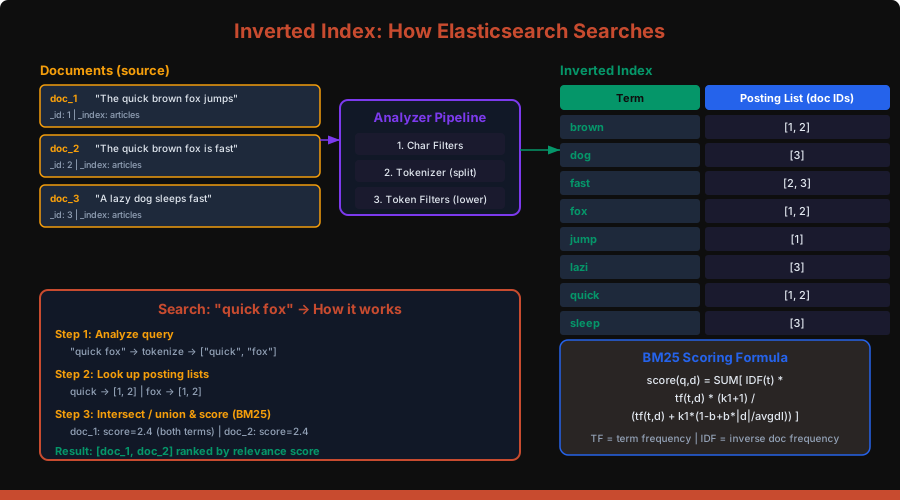
The inverted index is the data structure that makes Elasticsearch fast. Instead of scanning every document for a term, you look up the term and instantly get the list of documents containing it.
How Text Analysis Works
When a document is indexed, each text field goes through an analyzer pipeline:
"The Quick Brown Fox Jumps!"
        ↓ Character Filter (strip HTML, etc.)
"The Quick Brown Fox Jumps"
        ↓ Tokenizer (split on whitespace/punctuation)
["The", "Quick", "Brown", "Fox", "Jumps"]
        ↓ Token Filters (lowercase, stemming, stop words)
["quick", "brown", "fox", "jump"]
The same analyzer runs on the search query, so “Quick FOX” becomes ["quick", "fox"] — matching the indexed terms.
// Custom analyzer example
PUT /products
{
  "settings": {
    "analysis": {
      "analyzer": {
        "product_analyzer": {
          "type": "custom",
          "tokenizer": "standard",
          "filter": ["lowercase", "english_stemmer", "english_stop"]
        }
      },
      "filter": {
        "english_stemmer": { "type": "stemmer", "language": "english" },
        "english_stop": { "type": "stop", "stopwords": "_english_" }
      }
    }
  }
}
BM25: The Relevance Algorithm
Elasticsearch uses BM25 (Best Matching 25) to score documents. Two key factors:
- Term Frequency (TF) — how often the term appears in the document (more = higher score, with diminishing returns)
- Inverse Document Frequency (IDF) — how rare the term is across all documents (rarer = higher score)
score(q, d) = Σ IDF(t) × [tf(t,d) × (k1 + 1)] / [tf(t,d) + k1 × (1 - b + b × |d| / avgdl)]In interviews, you don’t need the formula — just know: rare terms matching frequently in short documents score highest.
Cluster Architecture
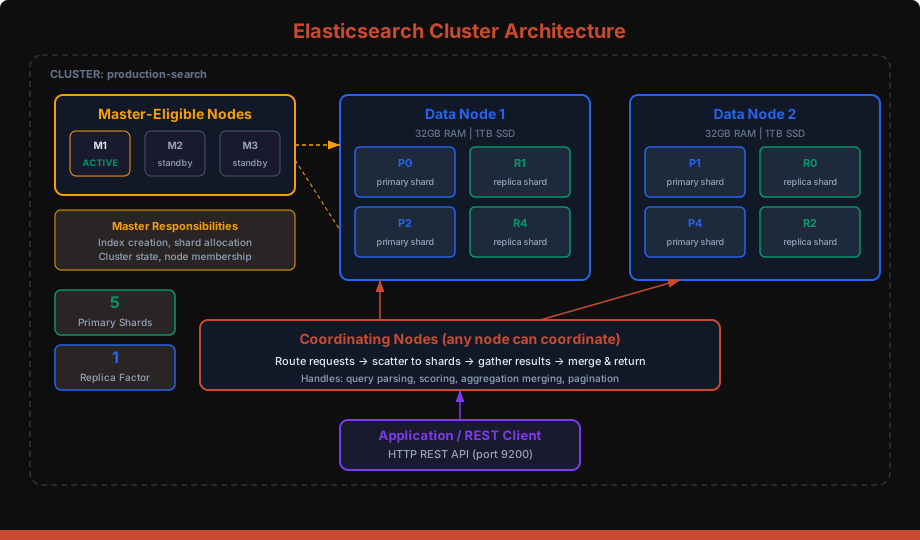
An Elasticsearch cluster is a collection of nodes, each serving one or more roles.
Node Roles
| Role | Purpose | Resource Profile |
|---|---|---|
| Master-eligible | Cluster state management, index creation/deletion, shard allocation | Low CPU/memory, high stability |
| Data | Stores shards, executes queries and aggregations | High memory, high disk I/O |
| Coordinating | Routes requests, merges results from shards | Moderate CPU/memory |
| Ingest | Pre-processing pipeline (transforms before indexing) | Moderate CPU |
| ML | Machine learning jobs | High CPU/memory |
Interview tip: In a production cluster, always have dedicated master nodes (typically 3) to prevent the cluster state from being affected by heavy data operations.
# elasticsearch.yml — dedicated master node
node.master: true
node.data: false
node.ingest: false

# elasticsearch.yml — dedicated data node
node.master: false
node.data: true
node.ingest: false
Shards: The Unit of Scale
An index is split into shards, each being a self-contained Lucene index.
// Create index with 5 primary shards and 1 replica
PUT /products
{
  "settings": {
    "number_of_shards": 5,
    "number_of_replicas": 1
  }
}
Shard routing formula:
shard_number = hash(_routing) % number_of_primary_shardsBy default, _routing = _id. This means the number of primary shards is fixed at index creation — you can’t change it later without reindexing.
Shard sizing guidelines:
- Target 10-50 GB per shard (sweet spot for most workloads)
- Each shard has overhead (~500MB heap), so don’t over-shard
- Too few shards = can’t scale writes; too many = overhead and slow queries
- Rule of thumb: number of shards = ceil(expected_data_size / 30GB)
Write Path: How Documents Get Indexed
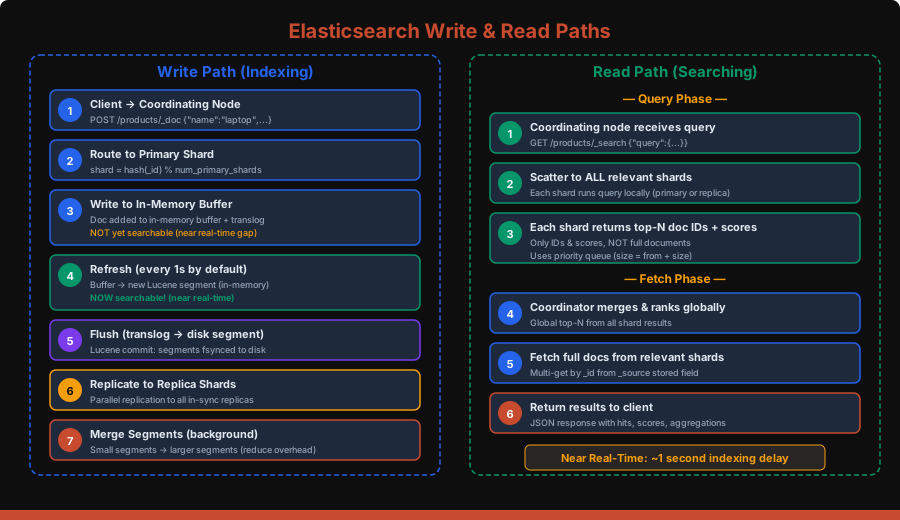
Understanding the write path is critical for interview discussions about consistency and latency.
Step-by-Step Write Flow
Key concepts:
-
Translog (Transaction Log): Write-ahead log for durability. Every write is appended to the translog before acknowledgment. If the node crashes before flush, the translog replays on restart.
-
Refresh: Every 1 second (configurable), the in-memory buffer is written to a new Lucene segment. This is when the document becomes searchable. This is why ES is “near real-time,” not real-time.
-
Flush: Periodically, all in-memory segments are fsynced to disk and the translog is cleared. This is the Lucene “commit” operation.
-
Merge: Background process that combines small segments into larger ones. Reduces the number of segments to search and reclaims space from deleted documents.
// Force refresh (make recent writes searchable immediately)
POST /products/_refresh

// Adjust refresh interval (e.g., for bulk indexing)
PUT /products/_settings
{
  "index.refresh_interval": "30s"
}

// Disable refresh during bulk load, re-enable after
PUT /products/_settings { "index.refresh_interval": "-1" }
// ... bulk index ...
PUT /products/_settings { "index.refresh_interval": "1s" }
Write Consistency
ES uses a primary-backup model:
- Write hits the primary shard
- Primary replicates to all in-sync replica shards in parallel
- Write is acknowledged only after primary + all in-sync replicas confirm
You can control this with the wait_for_active_shards parameter:
// Wait for all shards (primary + replicas) before acknowledging
PUT /products/_doc/1?wait_for_active_shards=all
{ "name": "laptop" }

// Wait for just the primary (faster, less durable)
PUT /products/_doc/1?wait_for_active_shards=1
{ "name": "laptop" }
Read Path: How Search Works
Scatter-Gather Pattern
Every search query follows the scatter-gather (two-phase) pattern:
Query Phase:
- Coordinating node receives the search request
- Forwards to one copy (primary or replica) of every relevant shard
- Each shard runs the query locally, returns only doc IDs + scores (top N)
- Coordinating node merges results into a global top-N list
Fetch Phase: 5. Coordinating node requests full documents for only the final top-N results 6. Returns complete JSON response to the client
// Search with explanation of scoring
GET /products/_search
{
  "query": {
    "bool": {
      "must": [
        { "match": { "title": "wireless headphones" } }
      ],
      "filter": [
        { "term": { "category": "electronics" } },
        { "range": { "price": { "lte": 100 } } }
      ]
    }
  },
  "sort": [
    { "_score": "desc" },
    { "created_at": "desc" }
  ],
  "from": 0,
  "size": 20
}
Interview insight: The filter context is critical for performance. Filters don’t calculate relevance scores and their results are cached in a bitset. Always put exact-match conditions (category, status, price range) in filter, not must.
Deep Pagination Problem
// Page 1: fast
GET /products/_search { "from": 0, "size": 20 }

// Page 500: SLOW — each shard must return 10,000 results
GET /products/_search { "from": 9980, "size": 20 }
Each shard must produce from + size results, the coordinator merges num_shards × (from + size) results. At deep offsets, this is extremely expensive.
Solutions:
// Solution 1: search_after (recommended for deep pagination)
// First page
GET /products/_search
{
  "size": 20,
  "sort": [{ "created_at": "desc" }, { "_id": "asc" }]
}
// Next page — use the last document's sort values
GET /products/_search
{
  "size": 20,
  "sort": [{ "created_at": "desc" }, { "_id": "asc" }],
  "search_after": ["2026-03-20T10:00:00", "abc123"]
}

// Solution 2: scroll API (for processing all results, e.g., export)
POST /products/_search?scroll=5m
{ "size": 1000, "query": { "match_all": {} } }
// Then: POST /_search/scroll { "scroll": "5m", "scroll_id": "..." }

// Solution 3: Point-in-time + search_after (best for concurrent readers)
POST /products/_pit?keep_alive=5m
// Returns: { "id": "pit_id_here" }
GET /_search
{
  "pit": { "id": "pit_id_here", "keep_alive": "5m" },
  "size": 20,
  "sort": [{ "created_at": "desc" }],
  "search_after": [...]
}
Mappings: Schema Design
Mappings define how fields are indexed and stored. Getting mappings right is essential for performance.
PUT /products
{
  "mappings": {
    "properties": {
      "title":       { "type": "text", "analyzer": "english" },
      "title_exact": { "type": "keyword" },
      "description": { "type": "text" },
      "price":       { "type": "float" },
      "category":    { "type": "keyword" },
      "tags":        { "type": "keyword" },
      "created_at":  { "type": "date" },
      "location":    { "type": "geo_point" },
      "in_stock":    { "type": "boolean" },
      "metadata":    { "type": "object", "enabled": false }
    }
  }
}
text vs keyword
text |
keyword |
|
|---|---|---|
| Analyzed | Yes (tokenized, lowercased, stemmed) | No (stored as-is) |
| Use for | Full-text search | Exact match, sorting, aggregations |
| Example | Product description | Category, status, email |
| Query | match, multi_match |
term, terms, range |
Common pattern: Map the same field as both:
{
  "title": {
    "type": "text",
    "fields": {
      "raw": { "type": "keyword" }
    }
  }
}
// Search on "title", sort/aggregate on "title.raw"
Dynamic Mapping Pitfalls
By default, ES auto-creates mappings for new fields. This is dangerous in production:
// Disable dynamic mapping to prevent mapping explosion
PUT /products
{
  "mappings": {
    "dynamic": "strict",
    "properties": { ... }
  }
}
// "strict" = reject docs with unmapped fields
// "false"  = accept docs but don't index unmapped fields
// "true"   = auto-map everything (default, risky)
Aggregations: Analytics at Scale
Aggregations run alongside search queries to compute summaries over matched documents.
GET /orders/_search
{
  "size": 0,
  "query": {
    "range": { "created_at": { "gte": "2026-01-01" } }
  },
  "aggs": {
    "revenue_by_category": {
      "terms": { "field": "category", "size": 20 },
      "aggs": {
        "total_revenue": { "sum": { "field": "amount" } },
        "avg_order_value": { "avg": { "field": "amount" } }
      }
    },
    "monthly_trend": {
      "date_histogram": {
        "field": "created_at",
        "calendar_interval": "month"
      },
      "aggs": {
        "revenue": { "sum": { "field": "amount" } }
      }
    }
  }
}
Three aggregation types:
| Type | Purpose | Example |
|---|---|---|
| Bucket | Group documents | terms, date_histogram, range, filters |
| Metric | Compute values | sum, avg, min, max, cardinality |
| Pipeline | Aggregate over other aggs | moving_avg, derivative, cumulative_sum |
Performance tip: Aggregations use doc_values (column-oriented on-disk data structure) by default for keyword and numeric fields. Never aggregate on text fields — use a keyword sub-field.
Common System Design Patterns
1. Product Search (E-commerce)
Key design decisions:
- Source of truth is the primary database, not ES
- Use CDC (Change Data Capture) or event-driven indexing to keep ES in sync
- Fetch full product details from the primary DB by ID after getting search results
- Use
filtercontext for faceted navigation (category, brand, price range)
2. Log Analytics (ELK Stack)
Index strategy for logs:
- Use time-based indices:
logs-2026.03.21 - Configure Index Lifecycle Management (ILM) to automatically:
- Hot → Warm → Cold → Delete
- Roll over when index hits 50GB or 30 days
// ILM policy
PUT _ilm/policy/logs_policy
{
  "policy": {
    "phases": {
      "hot":    { "actions": { "rollover": { "max_size": "50gb", "max_age": "1d" } } },
      "warm":   { "min_age": "7d",  "actions": { "shrink": { "number_of_shards": 1 }, "forcemerge": { "max_num_segments": 1 } } },
      "cold":   { "min_age": "30d", "actions": { "freeze": {} } },
      "delete": { "min_age": "90d", "actions": { "delete": {} } }
    }
  }
}
3. Autocomplete / Search-as-You-Type
// Mapping with completion suggester
PUT /products
{
  "mappings": {
    "properties": {
      "suggest": {
        "type": "completion"
      },
      "title": {
        "type": "search_as_you_type"
      }
    }
  }
}

// Index with suggestions
PUT /products/_doc/1
{
  "title": "Apple MacBook Pro 16-inch",
  "suggest": {
    "input": ["Apple MacBook Pro", "MacBook Pro 16", "laptop"],
    "weight": 10
  }
}

// Autocomplete query (extremely fast — uses FST, not inverted index)
GET /products/_search
{
  "suggest": {
    "product_suggest": {
      "prefix": "mac",
      "completion": {
        "field": "suggest",
        "size": 5,
        "fuzzy": { "fuzziness": 1 }
      }
    }
  }
}
4. Geospatial Search
// Find restaurants within 5km
GET /restaurants/_search
{
  "query": {
    "bool": {
      "must": { "match": { "cuisine": "italian" } },
      "filter": {
        "geo_distance": {
          "distance": "5km",
          "location": { "lat": 40.7128, "lon": -74.0060 }
        }
      }
    }
  },
  "sort": [
    {
      "_geo_distance": {
        "location": { "lat": 40.7128, "lon": -74.0060 },
        "order": "asc",
        "unit": "km"
      }
    }
  ]
}
Scaling Strategies
Horizontal Scaling Decision Matrix
Reindexing Without Downtime
You can’t change the number of primary shards or modify certain mapping properties on a live index. The solution is index aliases:
// Initial setup
PUT /products_v1 { ... }
POST /_aliases { "actions": [{ "add": { "index": "products_v1", "alias": "products" } }] }

// Application always queries "products" alias

// When you need to reindex:
PUT /products_v2 { ... }  // new settings/mappings
POST /_reindex { "source": { "index": "products_v1" }, "dest": { "index": "products_v2" } }

// Atomic swap
POST /_aliases {
  "actions": [
    { "remove": { "index": "products_v1", "alias": "products" } },
    { "add":    { "index": "products_v2", "alias": "products" } }
  ]
}
Performance Optimization Checklist
Indexing Performance
// Bulk API — always use for batch indexing
POST /_bulk
{"index":{"_index":"products","_id":"1"}}
{"title":"Laptop","price":999}
{"index":{"_index":"products","_id":"2"}}
{"title":"Phone","price":699}

// Optimal bulk size: 5-15 MB per request- Use bulk API — never index one document at a time
- Increase refresh interval to 30s during bulk loads
- Disable replicas during initial load, re-enable after
- Use
_routingto co-locate related documents on the same shard
Query Performance
- Use
filterovermustfor exact matches — filters are cached and skip scoring - Avoid wildcards at the start of terms (
*phoneis slow;phone*is fine) - Limit
from + sizeto under 10,000 — usesearch_afterfor deeper pagination - Use
_sourcefiltering to return only needed fields:
GET /products/_search
{
  "_source": ["title", "price", "category"],
  "query": { "match": { "title": "laptop" } }
}- Pre-warm field data for frequently aggregated fields
- Avoid scripts in queries when possible — use runtime fields or indexed fields instead
Cluster Health
// Check cluster health
GET /_cluster/health
// green = all shards allocated
// yellow = primary shards OK, some replicas unassigned
// red = some primary shards unassigned (data loss risk!)

// Check shard allocation
GET /_cat/shards?v&h=index,shard,prirep,state,node

// Check node stats
GET /_nodes/stats/jvm,os,fs
Elasticsearch vs Alternatives
| Feature | Elasticsearch | Apache Solr | Typesense | Meilisearch |
|---|---|---|---|---|
| Built on | Lucene | Lucene | Custom C++ | Custom Rust |
| Query language | Query DSL (JSON) | Solr Query / JSON | Simple API | Simple API |
| Scaling | Automatic shard rebalancing | Manual shard management | Built-in raft | Single node (HA planned) |
| Aggregations | Very powerful | Powerful | Basic | Basic |
| Typo tolerance | Manual (fuzzy) | Manual | Built-in | Built-in |
| Operational complexity | High | High | Low | Very low |
| Best for | Large-scale search + analytics | Enterprise search | Developer-friendly search | Small-medium search |
Interview Cheat Sheet
When to Use Elasticsearch
- Full-text search across large document collections
- Log/event analytics with aggregations
- Autocomplete and search-as-you-type
- Faceted navigation (e-commerce filters)
- Geospatial queries
- Real-time dashboards over time-series data
When NOT to Use Elasticsearch
- Primary data store — ES is not ACID, data loss is possible
- Frequent updates to the same document — each update = delete + reindex
- Strong consistency requirements — ES is eventually consistent (near real-time)
- Transactions — no multi-document transactions
- Small datasets — overhead isn’t worth it under ~100K documents
- Simple key-value lookups — use Redis or a database
Key Numbers to Know
| Metric | Typical Value |
|---|---|
| Indexing to searchable | ~1 second (refresh interval) |
| Search latency (simple) | 5-50 ms |
| Search latency (complex aggs) | 50-500 ms |
| Shard size sweet spot | 10-50 GB |
Max from + size |
10,000 (default) |
| Heap recommendation | 50% of RAM, max 31 GB |
| Shards per node | < 600 recommended |
Interview Answer Template
When an interviewer asks you to design a search feature:
- Source of truth — primary DB (PostgreSQL/MySQL), not ES
- Sync mechanism — CDC via Kafka/Debezium, or application-level dual writes
- Index design — define mappings, analyzers, shard count based on data size
- Query design —
boolquery withmustfor relevance,filterfor exact matches - Pagination —
search_afterfor deep pagination, neverfrom> 10,000 - Scaling — replicas for read throughput, time-based indices for logs, ILM for lifecycle
- Failure handling — what happens if ES is down? Degrade gracefully, queue writes for replay
Wrapping Up
Elasticsearch is a powerful tool, but it’s not a database replacement. It’s a secondary index — a read-optimized, denormalized view of your data that enables search and analytics capabilities that traditional databases can’t match.
The mental model for system design interviews:
- Write path: App → Primary DB → Event/CDC → ES (async, eventually consistent)
- Read path: App → ES for search/filter/aggregate → Primary DB for full record (if needed)
- Scaling: Shards for write parallelism, replicas for read throughput, ILM for data lifecycle
- Tradeoff: Near real-time (not real-time), eventually consistent (not strongly consistent), optimized for reads (not writes)
Master these concepts and you’ll be able to confidently design any search-heavy system in an interview.


