


If you’re a Senior Engineer (L5) preparing for Staff (L6+) roles at MAANG companies, this guide is for you. Not the generic “study LeetCode for 3 months” advice — a structured, week-by-week plan specifically calibrated for Staff-level expectations.
I’ve seen too many experienced engineers fail Staff interviews — not because they lack the skill, but because they prepare like they’re interviewing for Senior. The bar is fundamentally different.
What Makes Staff Interviews Different
At Senior level, you solve problems. At Staff level, you define problems, choose which ones to solve, and articulate why.
Here’s what changes:
| Dimension | Senior (L5) | Staff (L6+) |
|---|---|---|
| System Design | Design a single service | Design a system of systems |
| Scope | Component-level | Org-level, cross-team |
| Trade-offs | When asked | Proactively surfaced |
| Coding | Solve the problem | Solve it + discuss alternatives |
| Leadership | Led a project | Influenced technical direction |
| Communication | Explain your design | Drive the conversation |
The interviewer isn’t looking for the “right answer” — they’re evaluating whether you think like someone who owns technical direction for a team of 50+ engineers.
The Five Pillars
Every Staff interview loop at MAANG covers five areas, with varying weights depending on the company.
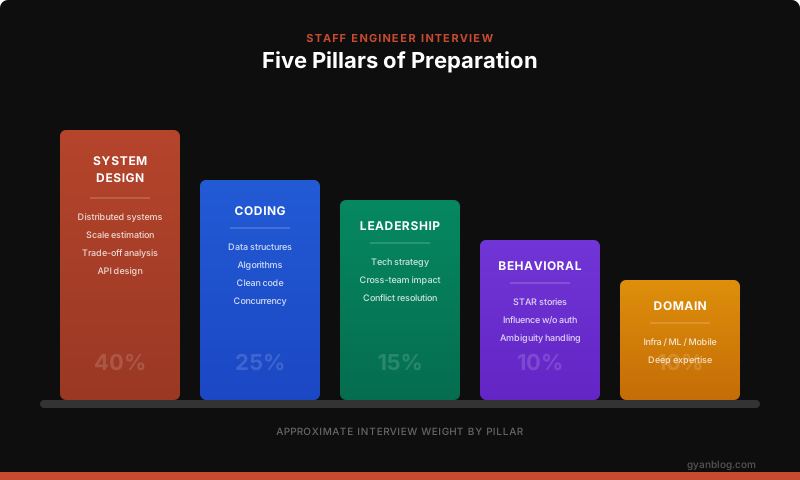
1. System Design (~40% of prep time)
This is the single biggest differentiator. At Staff level, you’re expected to:
- Drive the conversation, not follow the interviewer’s lead
- Make quantified capacity estimates (QPS, storage, bandwidth)
- Proactively identify bottlenecks before being asked
- Discuss trade-offs with alternatives you considered and rejected
- Think about operational concerns: monitoring, alerting, rollback, graceful degradation
2. Coding / DSA (~25% of prep time)
Yes, Staff engineers still do LeetCode rounds. The difference: you’re expected to write cleaner code, discuss time/space complexity without prompting, and handle follow-up variations fluently.
3. Technical Leadership (~15% of prep time)
This is the round that doesn’t exist at Senior level. You’ll be asked about technical strategy, how you’ve driven architectural decisions, resolved disagreements between teams, or deprecated legacy systems.
4. Behavioral (~10% of prep time)
STAR stories, but at Staff scale. Your impact stories need to show org-wide influence, not just team-level delivery.
5. Domain Deep-Dive (~10% of prep time)
Some companies (especially Google and Meta) have a round where you go deep into your area of expertise — infrastructure, ML, mobile, security, etc.
The 12-Week Study Plan
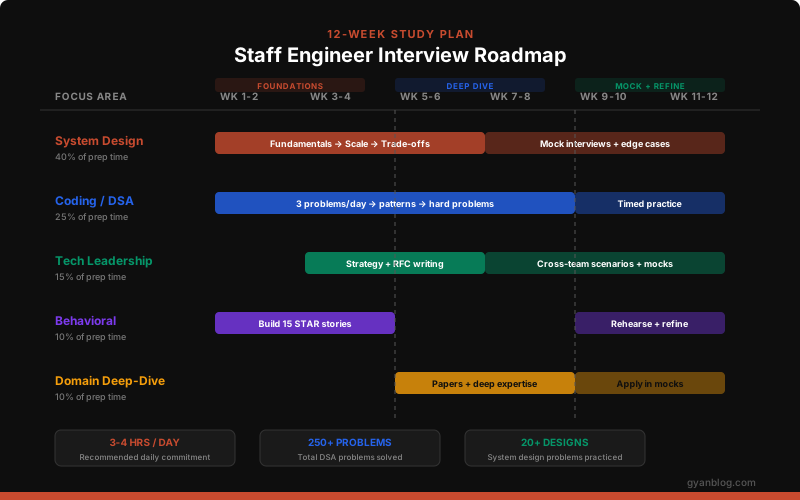
Phase 1: Foundations (Weeks 1-4)
Goal: Build the base. Get back into problem-solving shape and establish system design fundamentals.
Week 1-2: System Design Fundamentals + DSA Warm-up
System Design (2 hrs/day):
- Study the building blocks: load balancers, CDNs, caches, message queues, databases, sharding, replication
- Read through the fundamentals of distributed systems: CAP theorem, consistency models, partitioning strategies
- Practice back-of-envelope calculations
CAPACITY ESTIMATION TEMPLATE
============================
Users:         ___M total, ___M DAU
Read:Write:    ___:1 ratio
Avg request:   ___ KB
QPS:           DAU × avg_requests_per_user / 86400
Peak QPS:      QPS × 3 (rule of thumb)
Storage/year:  writes_per_day × avg_size × 365
Bandwidth:     QPS × avg_response_size
Coding (1.5 hrs/day):
- 3 problems/day on LeetCode (1 easy, 2 medium)
- Focus on pattern recognition: sliding window, two pointers, BFS/DFS, binary search, dynamic programming
- Write clean, production-quality code — variable names, edge cases, helper functions
Behavioral (30 min/day):
- Start building your STAR story bank
- List 15 significant projects from the last 3-5 years
- For each: Situation, Task, Action, Result — with quantified impact
Week 3-4: System Design Practice + DSA Patterns
System Design (2 hrs/day):
- Design 1 system per day from the classic list:
- URL shortener (warm-up)
- Rate limiter
- Chat system (WhatsApp/Slack)
- News feed (Twitter/Facebook)
- Notification system
- Search autocomplete
- Video streaming (YouTube/Netflix)
- Distributed cache
- Practice the 45-minute framework (covered below)
Coding (1.5 hrs/day):
- Move to medium + hard problems (2 medium, 1 hard)
- Focus on graph algorithms, advanced DP, and system-oriented problems (LRU cache, rate limiter, consistent hashing)
- Implement data structures from scratch: trie, heap, LRU cache, bloom filter
# LRU Cache — a Staff-level interview favorite
# Know this cold. Implement it in under 10 minutes.

class LRUCache:
    def __init__(self, capacity: int):
        self.capacity = capacity
        self.cache = {}        # key -> node
        self.head = Node(0, 0) # dummy head
        self.tail = Node(0, 0) # dummy tail
        self.head.next = self.tail
        self.tail.prev = self.head

    def get(self, key: int) -> int:
        if key not in self.cache:
            return -1
        node = self.cache[key]
        self._remove(node)
        self._add_to_front(node)
        return node.val

    def put(self, key: int, value: int) -> None:
        if key in self.cache:
            self._remove(self.cache[key])
        node = Node(key, value)
        self._add_to_front(node)
        self.cache[key] = node
        if len(self.cache) > self.capacity:
            lru = self.tail.prev
            self._remove(lru)
            del self.cache[lru.key]

    def _add_to_front(self, node):
        node.next = self.head.next
        node.prev = self.head
        self.head.next.prev = node
        self.head.next = node

    def _remove(self, node):
        node.prev.next = node.next
        node.next.prev = node.prev

class Node:
    def __init__(self, key, val):
        self.key, self.val = key, val
        self.prev = self.next = None
Phase 2: Deep Dive (Weeks 5-8)
Goal: Go beyond fundamentals. Tackle Staff-level complexity in system design and hard coding problems.
Week 5-6: Advanced System Design + Hard Coding
System Design (2.5 hrs/day):
- Move to complex, multi-system designs:
- Design Google Maps
- Design a payment system (Stripe)
- Design a distributed task scheduler
- Design a real-time multiplayer game backend
- Design a global content delivery network
- Design an ad serving system
- For each design, practice:
- Capacity estimation with real numbers
- Data model (schema + access patterns)
- API design (REST/gRPC contracts)
- At least 3 trade-off discussions
- Failure mode analysis
TRADE-OFF DISCUSSION TEMPLATE
==============================
Decision:     [e.g., SQL vs NoSQL for user data]
Option A:     PostgreSQL — strong consistency, ACID, joins
Option B:     DynamoDB — horizontal scale, low latency, no joins

Factors:
  - Read pattern:    80% by primary key → favors NoSQL
  - Write pattern:   Bursty, 50K writes/sec peak → favors NoSQL
  - Consistency:     Eventual OK for most reads → NoSQL acceptable
  - Joins needed:    User → Orders → Products → Reviews → SQL wins
  - Ops complexity:  Managed DynamoDB < self-hosted PG

Decision: DynamoDB for hot path (user profiles, sessions)
          PostgreSQL for transactional data (orders, payments)
Why:      Polyglot persistence — use each DB for its strength
Coding (1.5 hrs/day):
- Hard problems only: 2 per day
- Focus areas: graph algorithms (Dijkstra, topological sort), advanced DP (knapsack, interval scheduling), concurrency problems
- Practice explaining your approach out loud — time yourself to 35 minutes per problem
Tech Leadership (30 min/day):
- Study RFC/design document templates
- Practice writing 1-page technical proposals
- Review architecture decision records (ADRs) from open-source projects
Week 7-8: Cross-System Design + Leadership Scenarios
System Design (2.5 hrs/day):
- Focus on cross-system problems (the Staff differentiator):
- Design a migration from monolith to microservices
- Design a multi-region active-active database setup
- Design a platform-level feature flag system
- Design an observability platform (traces + metrics + logs)
- Design a CI/CD pipeline for 500 microservices
- Practice articulating org-level impact for each decision
Leadership (1 hr/day):
- Prepare for scenarios like:
- “Two teams disagree on the API contract. How do you resolve it?”
- “You need to deprecate a system that 10 teams depend on. Walk me through your approach.”
- “Your team’s tech debt is slowing down feature delivery by 40%. What do you do?”
- Write out your approach for each — not bullet points, full narratives
Coding (1 hr/day):
- Maintain with 1-2 problems/day
- Focus on code quality: clean abstractions, error handling, testability
Phase 3: Mock + Refine (Weeks 9-12)
Goal: Simulate real interviews. Identify and fix weak spots.
Week 9-10: Mock Interviews
Mock System Design (3 per week):
- Use platforms like Pramp, interviewing.io, or find a study partner
- Record yourself (screen + audio) and review
- After each mock, write down:
- What went well
- Where you got stuck
- What the interviewer had to prompt you on (these are red flags)
Mock Coding (3 per week):
- 45-minute sessions with a timer
- Practice thinking out loud
- Get feedback on communication, not just correctness
Behavioral Prep (1 hr/day):
- Rehearse your 15 STAR stories out loud
- Practice the “Tell me about a time…” format
- Ensure every story demonstrates Staff-level scope
STAR STORY QUALITY CHECKLIST (Staff Level)
==========================================
[ ] Impact spans multiple teams or the entire org
[ ] You drove the technical direction (not just executed)
[ ] You quantified the outcome ($, %, users, latency)
[ ] You handled ambiguity or conflicting priorities
[ ] You influenced without direct authority
[ ] You made a reversible/irreversible decision and explained why
[ ] The story took > 1 quarter to play out
Week 11-12: Final Push
- Run 2-3 full mock interview loops (system design + coding + behavioral back-to-back)
- Review your weakest areas from mock feedback
- Re-study the 5 system designs you struggled with most
- Rest the day before each interview — fatigue kills Staff interviews more than lack of knowledge
The 45-Minute System Design Framework
This is the framework I recommend for every system design interview at Staff level.
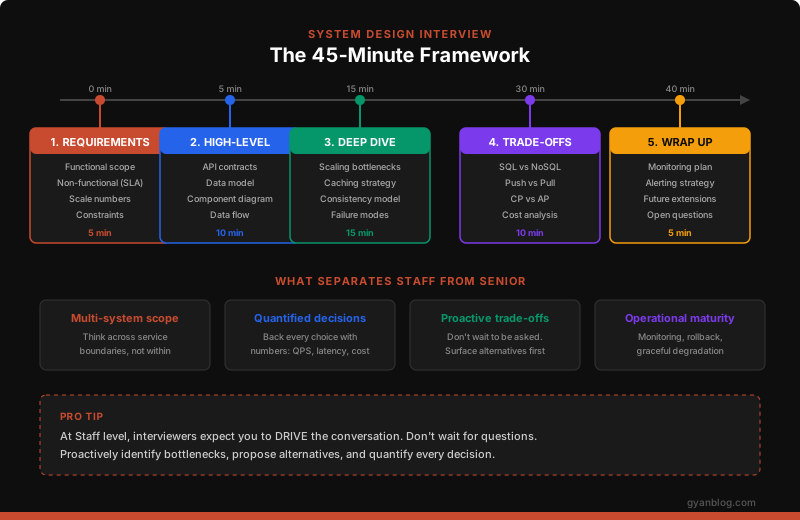
Phase 1: Requirements Gathering (5 min)
Don’t jump into drawing boxes. Start by scoping the problem.
QUESTIONS TO ASK:
- What's the primary use case? (functional requirements)
- What scale are we designing for? (users, QPS, data volume)
- What are the latency requirements? (p50, p99)
- What's the consistency model? (strong vs eventual)
- What's the availability target? (99.9%? 99.99%?)
- Are there any hard constraints? (budget, region, compliance)
At Staff level, you should be proposing the constraints, not just asking. “I’m going to assume 100M DAU with a 10:1 read-write ratio. The p99 latency target is 200ms for reads. Does that align with your expectations?”
Phase 2: High-Level Design (10 min)
Draw the major components and data flows. Keep it simple — 5-8 boxes max.
                    ┌──────────┐
    Clients ──────► │   API    │
                    │ Gateway  │
                    └────┬─────┘
                         │
              ┌──────────┼──────────┐
              ▼          ▼          ▼
         ┌────────┐ ┌────────┐ ┌────────┐
         │ Auth   │ │ Feed   │ │ Search │
         │Service │ │Service │ │Service │
         └───┬────┘ └───┬────┘ └───┬────┘
             │          │          │
             ▼          ▼          ▼
         ┌────────┐ ┌────────┐ ┌────────┐
         │User DB │ │Feed DB │ │Search  │
         │(PG)    │ │(Cass)  │ │(ES)    │
         └────────┘ └────────┘ └────────┘
Define API contracts upfront:
POST /api/v1/posts
  body: { content, media_ids[], visibility }
  response: { post_id, created_at }

GET /api/v1/feed?cursor=xxx&limit=20
  response: { posts[], next_cursor }
Phase 3: Deep Dive (15 min)
This is where Staff engineers separate themselves. Pick the 2-3 most critical components and go deep.
For a news feed system, you might deep-dive into:
-
Fan-out strategy: Push (write-time fan-out) vs Pull (read-time fan-out)
- Push: Fast reads (O(1)), expensive writes for users with 10M followers
- Pull: Cheap writes, expensive reads (fetch + merge + rank)
- Hybrid: Push for normal users, pull for celebrities
-
Ranking pipeline:
- Feature extraction → ML model scoring → re-ranking → diversification
- Latency budget: 50ms for ranking on pre-fetched candidates
-
Cache strategy:
- L1: Application-level cache (process memory, 10ms)
- L2: Distributed cache / Redis (feed objects, 5ms)
- L3: CDN for static media (images, video thumbnails)
- Cache invalidation: Write-through for user profiles, TTL for feed
Phase 4: Trade-offs & Alternatives (10 min)
Proactively discuss what you chose and what you didn’t.
"I chose Cassandra for the feed store because:
 - Write-heavy workload (100K writes/sec)
 - Partition key = user_id gives excellent locality
 - Eventual consistency is acceptable for feed reads

I considered PostgreSQL but rejected it because:
 - Single-writer bottleneck at this scale
 - Sharding PG adds significant operational complexity
 - We don't need ACID for feed data

I considered DynamoDB but it adds:
 - Vendor lock-in to AWS
 - Less flexibility for secondary access patterns
 - Higher cost at sustained high throughput"
Phase 5: Wrap Up (5 min)
Cover operational maturity — this is what most Senior candidates miss entirely.
- Monitoring: What metrics would you track? (p50/p99 latency, error rate, cache hit ratio, queue depth)
- Alerting: What triggers a page? (error rate > 1%, p99 > 500ms, queue depth > 10K)
- Rollback: How do you roll back a bad deploy? (feature flags, canary deploys, blue-green)
- Capacity planning: How do you handle 10x traffic spike? (auto-scaling, circuit breakers, load shedding)
System Design Problems by Company
Here’s what each MAANG company tends to focus on:
- Emphasis on scale and distributed systems
- Expect back-of-envelope math with real numbers
- Common problems: Design Google Docs, Gmail search, Google Maps routing, YouTube recommendations
- They care deeply about data modeling and consistency
Meta
- Heavy on news feed, social graph, real-time systems
- Common problems: Design Facebook Messenger, Instagram Stories, Facebook Marketplace, content moderation pipeline
- They value product thinking alongside system design
Amazon
- Service-oriented architecture, everything is a service
- Common problems: Design a warehouse management system, Amazon Prime Video, recommendation engine, order processing pipeline
- Leadership Principles are everywhere — even in system design discussions
Apple
- Focus on privacy, security, on-device processing
- Common problems: Design iMessage sync, iCloud storage, App Store search
- They care about end-to-end encryption and user privacy in your designs
Netflix
- Emphasis on resilience, chaos engineering, microservices
- Common problems: Design a video streaming pipeline, A/B testing platform, recommendation engine
- They want to see circuit breakers, fallbacks, and graceful degradation
Coding Patterns to Master
At Staff level, you need to solve LeetCode mediums in 15 minutes and hards in 25-30 minutes. Here are the patterns to drill:
Must-Know Patterns
# 1. Sliding Window — for substring/subarray problems
def max_subarray_sum(nums, k):
    window_sum = sum(nums[:k])
    max_sum = window_sum
    for i in range(k, len(nums)):
        window_sum += nums[i] - nums[i - k]
        max_sum = max(max_sum, window_sum)
    return max_sum

# 2. Two Pointers — for sorted array/linked list problems
def two_sum_sorted(nums, target):
    left, right = 0, len(nums) - 1
    while left < right:
        total = nums[left] + nums[right]
        if total == target:
            return [left, right]
        elif total < target:
            left += 1
        else:
            right -= 1

# 3. BFS/DFS — for graph traversal
from collections import deque
def bfs_shortest_path(graph, start, end):
    queue = deque([(start, [start])])
    visited = {start}
    while queue:
        node, path = queue.popleft()
        if node == end:
            return path
        for neighbor in graph[node]:
            if neighbor not in visited:
                visited.add(neighbor)
                queue.append((neighbor, path + [neighbor]))
    return []

# 4. Binary Search — not just sorted arrays
def find_minimum_in_rotated(nums):
    left, right = 0, len(nums) - 1
    while left < right:
        mid = (left + right) // 2
        if nums[mid] > nums[right]:
            left = mid + 1
        else:
            right = mid
    return nums[left]

# 5. Monotonic Stack — for next greater/smaller element
def next_greater_element(nums):
    result = [-1] * len(nums)
    stack = []  # indices
    for i in range(len(nums)):
        while stack and nums[i] > nums[stack[-1]]:
            result[stack.pop()] = nums[i]
        stack.append(i)
    return result
Concurrency — Staff-Level Favorite
// Read-write lock implementation — shows systems thinking
public class ReadWriteLock {
    private int readers = 0;
    private int writers = 0;
    private int writeRequests = 0;

    public synchronized void lockRead() throws InterruptedException {
        while (writers > 0 || writeRequests > 0) {
            wait();
        }
        readers++;
    }

    public synchronized void unlockRead() {
        readers--;
        notifyAll();
    }

    public synchronized void lockWrite() throws InterruptedException {
        writeRequests++;
        while (readers > 0 || writers > 0) {
            wait();
        }
        writeRequests--;
        writers++;
    }

    public synchronized void unlockWrite() {
        writers--;
        notifyAll();
    }
}
Behavioral Questions — Staff Level
These are the questions that trip up technically strong candidates. At Staff level, every answer needs to demonstrate:
- Org-wide impact — not just your team
- Technical leadership — you drove the direction
- Ambiguity handling — the problem wasn’t well-defined
- Quantified results — numbers, not feelings
Questions to Prepare
Technical Leadership:
- Tell me about a time you drove a significant technical decision that affected multiple teams.
- Describe a situation where you had to convince a senior leader to change technical direction.
- How did you handle a project where the requirements were ambiguous and constantly changing?
Conflict & Influence:
- Tell me about a time two teams disagreed on a technical approach. How did you resolve it?
- Describe a situation where you influenced without authority.
- Tell me about a time you had to push back on a product requirement for technical reasons.
Scale & Impact:
- What’s the most impactful technical project you’ve led? Walk me through it.
- Tell me about a time you improved developer productivity across the organization.
- Describe a system you designed that’s still running in production years later.
STAR Format at Staff Level
SITUATION: "Our monolithic deployment pipeline was causing 3-hour deploys
           for 12 teams. Any team's failed test blocked everyone."

TASK:      "I proposed and drove the migration to independent service
           deployments. This required buy-in from 4 engineering managers
           and changes to our CI/CD, monitoring, and on-call structure."

ACTION:    "I wrote an RFC with three options (modular monolith, service
           mesh, independent pipelines), got feedback from 30+ engineers,
           ran a 2-week prototype with one team, then rolled out
           incrementally over 3 months."

RESULT:    "Deploy time dropped from 3 hours to 12 minutes per service.
           Deploy frequency went from 2/week to 8/day across the org.
           We measured a 40% reduction in time-to-production for new
           features in the quarter following full rollout."
Resources — Curated, Not Exhaustive
System Design
- Designing Data-Intensive Applications by Martin Kleppmann — the bible. Read it cover to cover.
- System Design Interview Vol 1 & 2 by Alex Xu — good structured walkthroughs
- Company engineering blogs — Meta Engineering, Netflix Tech Blog, Google Research, AWS Architecture Blog
- Papers: Dynamo, Bigtable, MapReduce, Raft, Spanner — read the originals
Coding
- LeetCode — filter by company, sort by frequency. Focus on Top 100 Liked + company-specific
- NeetCode 150 — curated pattern-based list
- Grokking the Coding Interview — pattern-based approach
Leadership & Behavioral
- The Staff Engineer’s Path by Tanya Reilly — essential reading
- An Elegant Puzzle by Will Larson — systems thinking for eng leadership
- StaffEng.com — real stories from Staff+ engineers
Common Mistakes
-
Preparing like a Senior interview. The biggest trap. You need to demonstrate scope and judgment, not just technical skill.
-
Spending too much time on coding, not enough on system design. System design is 40% of the evaluation. Many engineers default to LeetCode because it feels more productive.
-
Not practicing out loud. Staff interviews are conversations. You need to think out loud, drive the discussion, and handle interruptions gracefully.
-
Generic behavioral answers. “I led a project and it went well” doesn’t work. You need specifics: team size, timeline, metrics, org-level impact.
-
Ignoring operational concerns in system design. If your design doesn’t include monitoring, alerting, and failure modes — it’s a Senior answer, not Staff.
-
Not quantifying decisions. “I chose Redis for caching” is Senior. “I chose Redis for caching because our read pattern is 95% by primary key, we need sub-5ms p99 latency, and the working set fits in 64GB of memory” is Staff.
Daily Schedule Template
For someone with a full-time job preparing for Staff interviews:
WEEKDAY SCHEDULE (3.5 hrs)
==========================
Morning (before work):
  06:00 - 07:00  System Design study/practice
  07:00 - 07:30  1 LeetCode problem

Evening (after work):
  20:00 - 21:00  System Design practice/mock
  21:00 - 21:30  1-2 LeetCode problems
  21:30 - 22:00  Behavioral prep / leadership reading

WEEKEND SCHEDULE (5-6 hrs)
==========================
  09:00 - 11:00  Full system design practice (end-to-end)
  11:00 - 12:00  3 LeetCode problems (timed)
  14:00 - 15:00  Mock interview (system design or coding)
  15:00 - 16:00  Review mock feedback + fill gaps
  16:00 - 16:30  Behavioral story rehearsal
Final Thoughts
Staff interviews at MAANG are hard — rejection rates are higher than Senior, and the bar is more subjective. But the preparation process itself makes you a better engineer. Even if you don’t get the offer on your first attempt, the system design thinking, leadership narratives, and problem-solving patterns you build will compound throughout your career.
The most important thing: start. Don’t spend a week optimizing your study plan. Pick a system design problem, open a blank page, and start designing. The plan will adjust as you discover your weak spots.
Good luck. Ship it.


